One Jackson Hole broker recently told a Wyoming news outlet that the people shaping Teton Village's future are already anticipating "a lot of change" over the next decade. He was talking about a slow-moving master plan effort to turn surface parking lots into a walkable village core. He was not talking about the number that actually catches most buyers' attention first: the median sale price.
That number has been doing something odd all year. In January 2026, Redfin's data showed a median sale price for Teton Village of $8.0 million, up 60.1 percent from a year earlier. By August, the same source put the median at $2.31 million, up 92.5 percent year over year. Two headline numbers, both technically accurate, pointing in different directions depending on which month you happened to check. If you're comparing Teton Village to other Jackson Hole neighborhoods on price alone, you're comparing against a number that moves more than the market underneath it does.
What the Numbers Actually Say
Here's what a snapshot of Teton Village pricing looked like through the first eight months of 2026:
Metric | Figure | Window |
|---|---|---|
Median sale price, all property types | $8.0M (+60.1% YoY) | January 2026 |
Median sale price, all property types | $2.31M (+92.5% YoY) | August 2026 |
Single-family entry point | above $1.25M | current listings |
Average single-family listing price | $11.24M | current listings |
Condo price range | $640,000 to $11,500,000 | current listings |
Typical days on market | 114 to 162 days | 2026 |
None of these figures contradict each other. They describe a market small enough that its statistics behave less like a stable trend line and more like a handful of coin flips reported as a batting average.
A Village Too Small to Average Normally
Teton Village has roughly 500 households. At any given time, there might be a dozen to two dozen condos listed for sale, plus a handful of single-family homes and townhomes. When a market that thin closes even three or four ultra-luxury properties in the same month, the median doesn't drift. It jumps. That's the mechanical reason January showed $8 million and August showed $2.3 million. It has less to do with the neighborhood cooling off or heating up and more to do with which properties happened to close escrow that month.
This is worth sitting with if you're using Teton Village's numbers to benchmark against Wilson, Jackson, or Teton Pines. Those neighborhoods have less property type variation, which smooths their medians into something closer to a real trend. Teton Village has a variety of property types including large homes, condos, condo-hotels, and fractional ownership properties, and every headline price you read there should come with an asterisk about sample size.
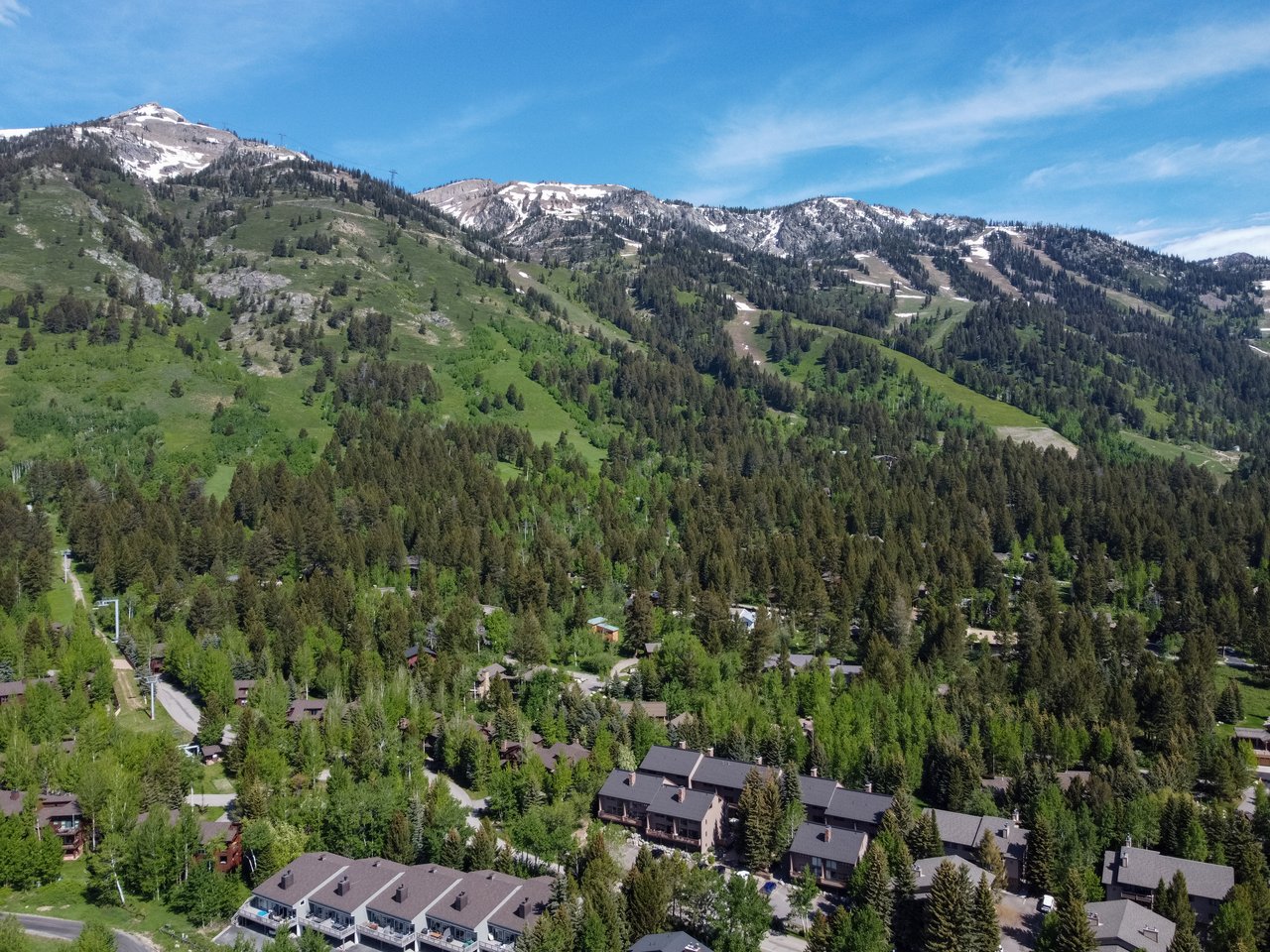
The scarcity behind that thin trading volume isn't a market quirk. It's geography. Grand Teton National Park and the Bridger-Teton National Forest hem the village in on nearly every side, and county zoning was written specifically to prevent sprawl beyond the resort's original footprint. There is close to no raw land left to develop. Whatever gets built next has to come from redeveloping older buildings or waiting for a legacy property to change hands, which is exactly why so few transactions happen here relative to the attention the neighborhood gets.
The Ceiling Nobody's Listing Sheet Mentions
There's a second, less visible number that matters more than any single month's median: how much room is actually left to build.
Teton Village's Area 1 Master Plan was adopted in 1998. A Teton County planning document presented to the Board of County Commissioners in February 2026 noted that 26 years after that plan took effect, the area is still only 63 percent built out based on approved plans of operation. That's not a market opinion. It's a county measurement of how much of the entitled development has actually been constructed.
Read that number the way a long-term buyer should read it. It means roughly a third of what the original master plan allows for still hasn't been built, which puts a real ceiling on future inventory, but it's a ceiling with an end date rather than a wall with no door. County planners were still working through text amendments to a related master plan section as recently as May 2026, adjusting things like where a future transit center gets sited and how public facility obligations get triggered. The village isn't finished changing shape, and the pace of that change, not the month-to-month median, is the number that tells you where value is headed.
The $350 Million Signal
If you want evidence that people with real capital and long time horizons are reading the market this way, look at what happened to the Four Seasons Resort and Residences Jackson Hole earlier this year.
Host Hotels and Resorts had purchased the property from Dajia Insurance Group in 2022 for somewhere around $300 million in cash. In February 2026, Host sold it again, this time as part of a package deal with the Four Seasons Orlando at Walt Disney World, to the private investment firm BDT & MSD Partners, backed by Dell Technologies founder Michael Dell. The Jackson Hole property alone was valued at an estimated $350 million in that transaction.
That's a firm with access to enormous capital choosing to pay a premium for a resort sitting inside a neighborhood with almost no room left to expand and a master plan that's still, by the county's own measurement, more than a third unbuilt. Institutional buyers aren't pricing off January's median or August's median. They're pricing off scarcity that doesn't reset every quarter.
Reading Past the Median
If you're actually shopping in Teton Village, a few adjustments make more sense than watching the median swing:
Price per square foot tells you more than the median sale price, because it strips out the effect of one enormous estate or one small condo closing in a given month. Days on market matters too. At 114 to 162 days typical, Teton Village properties move slower than the broader Jackson Hole market, which usually means pricing has to be precise from the start rather than adjusted downward later.
Location within the village still separates value more than any citywide statistic. Ski-in, ski-out access, unobstructed Teton views, and proximity to the base of the Bridger Gondola carry a real premium over units set back from the lift infrastructure. Some of the valley's highest-end condo product, including private-club style residences, sits inside the village specifically because that access is part of what's being sold.
And because Teton Village is one of the few areas in Teton County where short-term rental use is permitted under current zoning, that legal status shapes what a given unit is worth to a buyer who plans to rent it. It's one more reason two properties with similar square footage can carry very different price tags, and one more reason the county's own zoning and master plan documents are worth reading before you assume a unit's income potential.
A Few Questions We Hear Often
Why do different real estate websites show such different median prices for Teton Village? Because the neighborhood has so few transactions in a given month, the median is highly sensitive to which specific properties happen to close. A source pulling data for January will show a different picture than one pulling data for August, even without anything changing about underlying demand.
Does the Four Seasons sale affect the value of nearby condos and homes? It doesn't move anyone's assessed value directly, but it does signal how institutional buyers are pricing long-term scarcity in the village, which is the same scarcity that supports values across the neighborhood's smaller residential properties.
Is there still room for new construction in Teton Village? Some. The county's own figures put the Area 1 Master Plan at 63 percent built out as of early 2026, which leaves entitled but unbuilt capacity. How and where that gets developed is still being worked out through ongoing master plan amendments.
If you're weighing a purchase in Teton Village against other options in Jackson Hole, the conversation is rarely about a single price point. It's about reading scarcity, entitlement limits, and transaction volume together, which is exactly the kind of local interpretation a single data point can't give you. Budge Kelley Realty Group has spent decades watching this specific market move. Browse Homes with us before you let one month's median make the decision for you.